
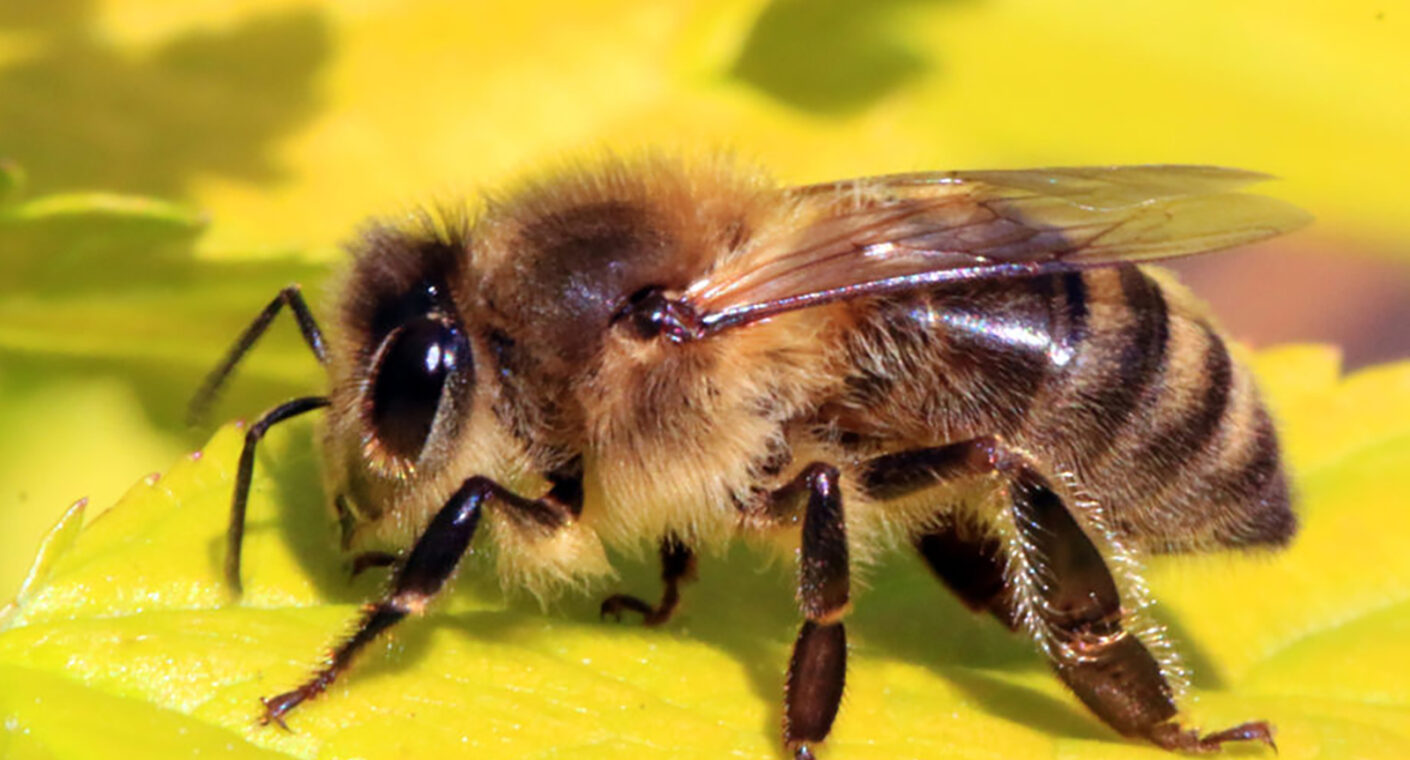
Bees are intimately linked to the evolution of humankind as social beings. Present on Earth for over 60 million years, the evolutionary development of this insect has been closely intertwined with that of flowering plants, fruits, and seeds. Fossil evidence of bees predates that of humans. From this plant-insect relationship arises the ecological and economic importance attributed today to beekeeping, an agricultural activity that guarantees the seeds of plant species best adapted to the environment. According to the FAO, bees are responsible for the pollination of at least 70% of the crops that serve as food for humans.
Apis mellifera or honeybee
It is a social insect whose activities or functions are conditioned by the time of year and the ages of the female and male individuals that comprise it and form the castes. Each colony has two female castes: a queen and 25,000 to 80,000 workers, and one male caste, drones, which number in the hundreds when the colony is in its multiplication phase.
The behavior of a honeybee colony is regulated by pheromones produced primarily by the queen bee, the climatic conditions of the ecosystem, and the flow of nectar. As the availability of nectar, pollen, water, and propolis increases, the colony begins to develop due to the queen bee’s increased egg-laying. This activity determines the development of the brood nest and the birth of worker bees, the adult population responsible for multiple tasks, primarily the collection of food that they increasingly demand.
When a colony’s population grows beyond the capacity of all bees to access the pheromones that bind the swarm together, or beyond the physical space they inhabit, a division process begins, resulting in the production of new queens. The first queen to emerge triumphs and mates with drones in the breeding area. The old queen will then leave the colony, taking approximately 60% of the worker bees with her to found a new colony.
As a characteristic of social insects, bee colonies have a division of labor:
One aspect that fruit growers should keep in mind when receiving their pollinators is that it’s not the wood that will do the work, but the population contained within it.
The Cuban veterinarian advises paying attention to management practices appropriate to the bee population:
A hive without a population cannot maintain the necessary temperature of 34-35°C. I’ve seen empty spaces in hives in Chile during the cold season. How can so few bees thermoregulate such a large space?” For this purpose, the Langstroth hive is like an accordion, with its movable honeycombs.
Young worker bees feed and care for the queen and brood
- Young worker bees feed and care for the queen and brood, while older bees collect pollen, nectar, propolis, and water, and defend the colony against potential invaders. Adult worker bees regulate the temperature and humidity of the nest (homeostasis), ensuring virtually constant values even when external environmental conditions change. Any deviation from these behaviors indicates a loss of well-being or leads to a decline in health.
There are more than 20,000 species of bees that live solitary lives or have varying degrees of social organization.
The genus Apis
The genus Apis includes species such as Apis dorsata, or the giant Indian bee, and Apis florea, or the Indian dwarf bee, among others. The first four races are the most in demand for large-scale beekeeping, while the African A. m. scutellata, raised in tropical regions of the African continent, gained economic interest when introduced to the Americas and crossbred with the native bee, resulting in an Africanized hybrid that, as it spread across the continent, became economically and socially important.
The hybrids resulting from crossbreeding have necessitated adapting beekeeping practices to the insect’s defensive and swarming behavior, challenges not present in the A. mellifera mellifera and A. mellifera ligustica races.
In Cuba, various races are mixed, adapted to local ecosystems, with Apis mellifera mellifera and Apis mellifera ligustica predominating.
It is essential to continue studies that allow for the genetic characterization of the Cuban bee, the result of targeted selection and controlled reproduction in specialized centers, under a national guiding program, without excluding the inevitable contribution of drones from wild colonies.
The genetic characteristics are preserved by the country’s island status and regulations on importing live bees, queen bees, or semen. The Africanization of the continent, although African races are not present, constitutes a significant risk for Cuba, and their introduction would require the implementation of new management strategies.
More than 26 races or subspecies of the Apis mellifera species:
- Apis mellifera ligustica – Italian bee
- Apis mellifera mellifera – German black bee
- Apis mellifera carnica – carnivorous bee
- Apis mellifera caucasica – Caucasian bee
- Apis mellifera scutellata – African bee
- Apis mellifera adansonii – African bee
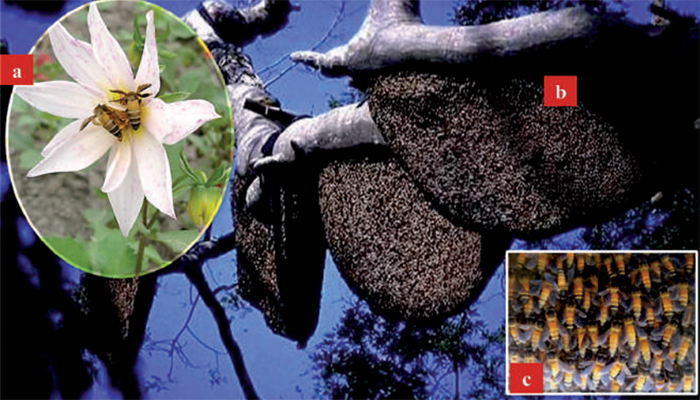
Apis dorsata or Indian giant bee:
On a flower (a), natural colonies, with a single honeycomb (b) and grouped on the honeycomb (c).
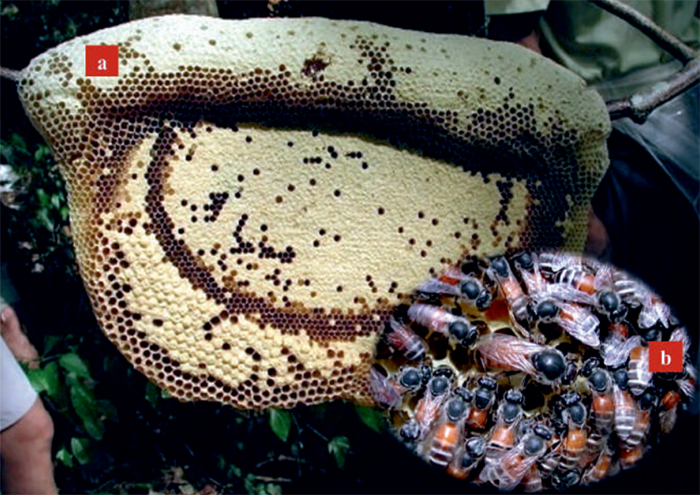
Apis florea:
or Indian dwarf bee
Apis melifera:
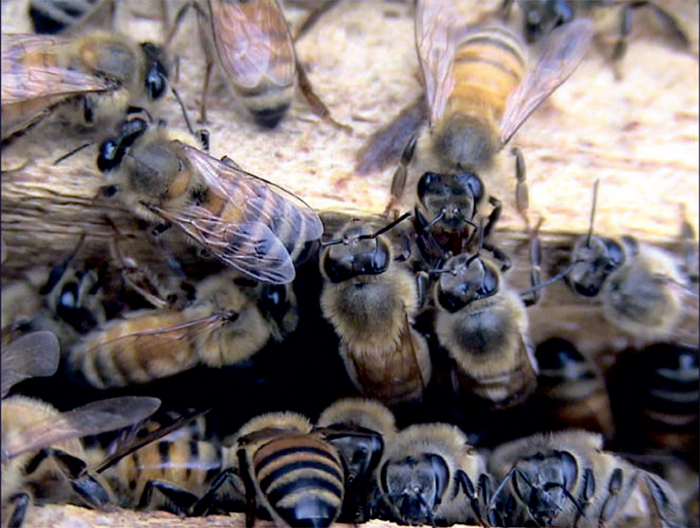
Present in Cuba. It is the result of natural crossbreeding and genetic improvement work. Photos by the authors. Cuba, 2009
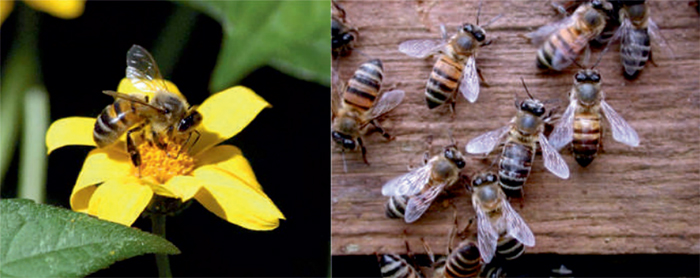
Africanized bees from Nicaragua:
To determine if a honeybee is Africanized, specialized analytical techniques are required to differentiate, among other things, morphometric and enzymatic patterns, or mitochondrial DNA. Photo: Courtesy of MSc. Danilo J. Román Platas. Nicaragua, 2010.
Main characteristics of the honeybee, according to Linnaeus, C. (1707-1778), adapted by the International Code of Nomenclature, instituted in 1898
| CLASSIFICATION | MAIN FEATURES |
| Kingdom: Animalia | Animal |
| Subkingdom: Metazoa | Pluricellular |
| Phylum: Arthropoda | Body divided into segments, articulated appendages, and chitinous exoskeleton |
| Class: Insecta | With a head, thorax, abdomen, and three pairs of legs |
| Orden: Hymenoptera | Membranous wings and licking-chewing mouthparts. Complete metamorphosis |
| Familia: Apidae | Solitary and social. With anatomical structures for transporting pollen and nectar. |
| Genus: Apis | Store the honey in honeycombs |
| Species: Apis mellifera (mellifica) L. | Bee language |
Taken from the book: Beekeeping: Health and Production, by:
- Dr. Mayda Verde Jiménez
Apiculture Specialist. Member of the Food Hygiene Society of the Cuban Veterinary Scientific Council. - Dr. Jorge Demedio Lorenzo, PhD.
Professor of Parasitology and Apiculture. Doctor of Veterinary Sciences. Agrarian University of Havana “Fructuoso Rodríguez”. Ministry of Higher Education, Cuba. - Dr. Tomás Gómez Bernia, MSc.
Senior Specialist. Food Safety Group.
Master of Science. National Directorate. Institute of Veterinary Medicine. Ministry of Agriculture.
President of the Food Hygiene Society of the Cuban Veterinary Scientific Council.