
Managed honeybees play an important role as pollinators. The health and nutritional condition of honeybee colonies (Apis mellifera L.) depends for an important part on management practices, and it is influenced by multiple factors. This study aims to identify the stressors that lead to the loss of honeybee health and its consequences on the colony’s productivity.
Bee Health and Productivity in “Apis mellifera”, a Consequence of Multiple Factors
Different aspects related to management practices, productivity, clinical observations related to diseases, presence of sanitary gaps in the apiaries, colony strength, weather and infestation rates by Varroa sp. mites were measured. The information was collected during two monitoring in 53 apiaries in the Province of Santa Fe, Argentina.
The most important factors:
The most important factors affecting the productivity of the studied honeybee colonies were nuclei preparation, the number of combs in the brood chamber, change of bee queen, disinfection of beekeeping material, among other less significant ones. Although honey production is important in the region, the colony strength was deficient and inadequate during both monitoring. Due to its dependence on management by the beekeeper, it is suggested that a holistic approach could improve bee health, increasing the productivity of honeybees.
The results show correlations among many of the management practices, health condition and yield.
Introduction:
Pollinators perform a crucial ecological function that supports most of the world’s plant diversity, associated organisms and global agriculture. Crop yield and quality depend on both the abundance and diversity of pollinators. In the particular case of honeybees (Apis mellifera L.), they can be confined and managed in artificial structures. It allows them to be transported and subject to human selection, but unrestricted as they forage in the surrounding landscape. Beekeepers attempt to optimize colony health, which in turn depends for an important part on management practices.
Regarding the production of honey in Latin America, Argentina stands out in the first place, contributing with 7.4% of the world’s total honey exports. Country-wide, the average honey production is estimated at 25 kg per colony each year. The yield is highly variable throughout the territory due to the diversity of the ecosystems’ flowering plants on the one hand, and different technological capacities of producers on the other. Despite productivity, colony losses are estimated at around 34% per year in the country. The losses are attributed mainly to the indiscriminate use of agrochemicals and malnutrition.
Materials and Methods
2.1. Experimental Design and Bee Colonies Selection
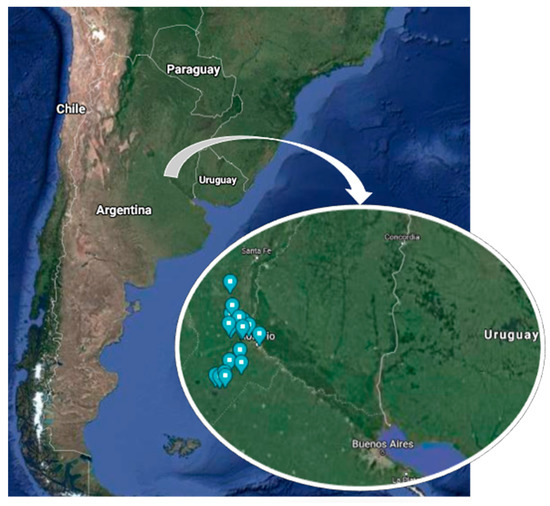
- To identify some of the multiple factors related to bee health and productivity of Apis mellifera colonies, 53 apiaries (managed by 53 different beekeepers) located in the south of Santa Fe Province, Argentina (28° S 59° W and 34° S 63° W), were studied during 2019. The selection was based on criteria such as production, homogeneity of the agricultural-economic zones, and the location near the access routes. Apiaries were visited and monitored two times. The first monitoring (53 apiaries, 265 hives) was performed forward between April and May, coinciding with autumn. The second one (49 apiaries, 241 hives) was conducted between September and October, at the beginning of spring. Monitoring was carried out with the owner’s consent, selecting five bee colonies (hives) at random from each apiary. Colonies with large amounts of dead adult bees at the entrance, with only dead bees inside or decomposing brood or orphaned colonies, were excluded. The selected hives were labelled with an alphanumeric code. During the second monitoring, those colonies that were not physically found due to abandonment or death were recorded and replaced (to comply with the proposed activities), but not included on the statistical analysis. All the colonies in the experiment were managed under the same conditions as the rest of the bee colonies in the selected apiary.
2.2. Methodology for Collecting Field Data
Field data were collected through a survey. The following aspects were considered: General information about the beekeeper and socioenvironmental elements that may impact or are related to bee health; zootechnical and sanitary factors related to the development of diseases; manifestations of clinical signs associated with diseases (affecting adult bees or their brood) and presence of sanitary gaps in the apiaries. A sanitary gap is defined as a condition that makes bee colonies vulnerable to etiological agents or to lose their health. Before intervening in the hives, the wind speed (km/h), the geographical location of the apiary (GPS), temperature (°C), relative humidity (%RH) and the number of bees entering the hive entrance for one minute, were recorded.
2.3. Infestation Rate (IR%) by Varroa sp. Mite
To complement the information obtained during the surveys, the rate of infestation by the Varroa sp. mite was calculated using a standard method. For this purpose, a sample of about 300 adult bees was collected from frames with capped brood. The bees were preserved in hermetically sealed glass jars containing a hydroalcoholic solution (75% ethanol). The bottles were labelled and transported on ice (0 °C) to the laboratory for further analysis.
2.4. Honeybee Colony Strength
The honeybee colony strength was determined by the semi-subjective Liebefeld method slightly modified, based on visual estimates by an observer. Briefly, all the combs of the selected hives were considered, according to the corresponding brood chamber (1, 2, etc.). During the review, the following parameters were used: adult bee population, amount of open and capped brood, and the proportion of honey and pollen. The minimum unit of quantification used is 1/4 of one side of the frame and the sum of both sides (8/4) is equivalent to the result obtained for each frame (two sides of the comb).
2.5. Statistical Analysis
To build a database for statistical analyses, the information was processed, weighted and entered according to the date and the type of variable. Statistical and descriptive analyses were performed in the software IBM SPSS 22.0 (SPSS Inc., Chicago, IL, USA). Descriptive analyses are reported as a frequency or percent of the total sample (N = 53 apiaries and 53 beekeepers) or the arithmetic mean values ± SD and the minimum-maximum values, depending on each variable. To establish a possible correlation between variables, a bivariate Pearson’s correlation analysis was carried out (95% confidence). The Benjamini and Hochberg (1995) method to control the false discovery rate was incorporated to the correlation analysis. The respective correlation coefficient (Pearson’s r) and the corrected significance value (p) were presented in each case. To find significant differences and to explain the variability between the studied apiaries and colonies, according to the estimated yield (kg of honey/colony/year), non-parametric tests were applied (Kruskal–Wallis or Mann–Whitney U tests, α = 0.05).
Verónica Rachel Olate-Olave,
Mayda Verde,
Leslie Vallejos,
Leonel Perez Raymonda,
Maria Carla Cortese,
Marnix Doorn